
There are two ways a sunscreen can keep ultraviolet light off your skin, and the difference comes down to where the work happens. Chemical filters sink into the upper layers of the skin and absorb UV rays, converting them into heat. Mineral sunscreen does something simpler and more physical: it sits on the surface and reflects, scatters, and partially absorbs light before it even reaches you. If you only knew the second kind by its reputation for a chalky white cast, this deserves a second look, because formulas have changed.

What Mineral (Physical) Sunscreen Actually Does
Mineral sunscreen, also called physical sunscreen, relies on a mineral UV filter instead of a chemical one. The most common filter is zinc oxide, and the most important detail is particle size. Non-nano zinc oxide is made of particles larger than 100 nanometers, meaning they are too large to pass through the skin. They stay on the surface and form a thin shield that reflects and scatters both UVA and UVB rays.
This surface mechanism has one practical consequence worth knowing: mineral filters work the moment they are on the skin, while chemical filters need time to settle and bind before becoming fully active. That’s general ingredient science, not a property unique to any brand, but it’s why mineral formulas are often described as protective from the moment you finish applying.
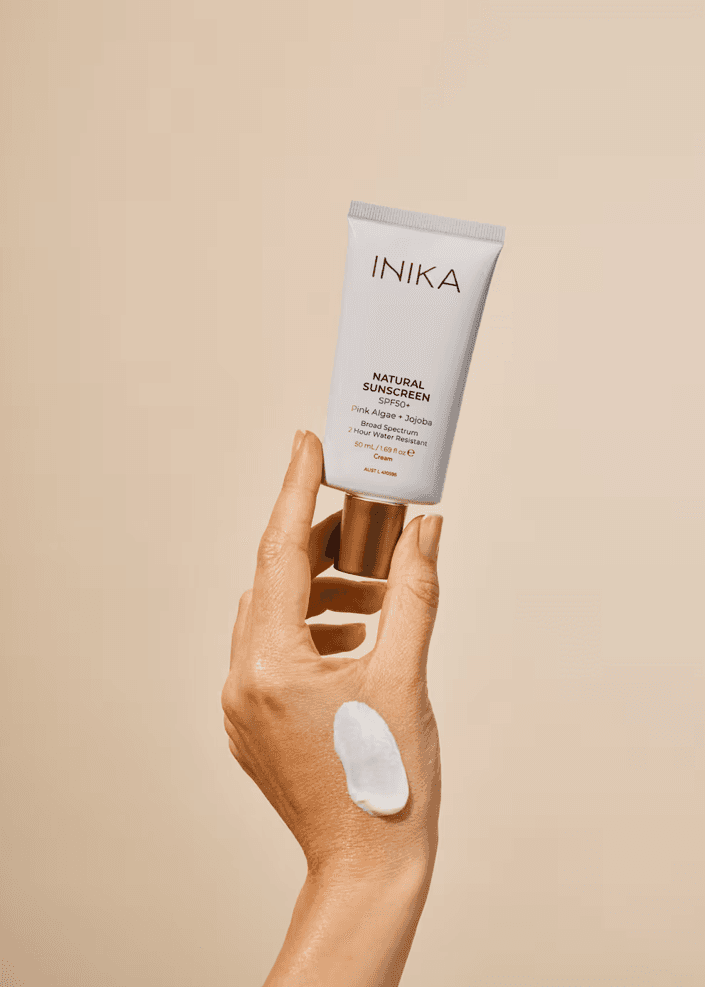
A useful practical example is INIKA Organic Natural Sunscreen SPF50+, a 100% physical sunscreen built around non-nano zinc oxide at a concentration of 22.75% w/w. It’s broad-spectrum, covering both UVA and UVB, and creates an invisible shield on the skin’s surface rather than absorbing rays as chemical filters do. We’re using it here not as a sales pitch, but as proof that a fully mineral formula can be cosmetically elegant.

The White Cast Problem and How Modern Formulas Solve It
Zinc oxide is inherently a white, opaque powder. This is why older mineral sunscreens left a pale cast, and why so many people quietly gave up on them. The good news is that this is a formulation problem, and formulators have largely solved it. There are three levers, all general ingredient science, not a secret of any individual brand.
Micronization: grinding the zinc oxide into much smaller particles that still remain above the 100-nanometer non-nano threshold, so the powder disappears more easily without sinking into the skin.
Surface coatings: inert coatings on each particle to help them spread evenly and not clump into visible patches.
Tinting: a touch of iron oxide pigment that blends the cast with various skin tones.
It’s this lever that INIKA pulled. The SPF50+ is formulated to absorb easily and remain completely transparent, which is how a high-percentage zinc formula can look invisible rather than chalky. If a dewy finish is the goal, it also serves as a hydrating base for a radiant foundation; if you prefer matte, it can be set with INIKA Matte Perfection Primer.
INIKA OrganicPrimer - Matte Perfection3,070 ден.Погледни
Everyday Use: The 20-Minute and 2-Hour Rhythm
Sun protection is less about the product and more about the habit. General dermatological recommendations from bodies like the AAD are consistent: choose a broad-spectrum, water-resistant sunscreen with an SPF of 30 or higher, apply it 15 to 30 minutes before going outside, and reapply every two hours, plus immediately after swimming, sweating, or towel drying. SPF 30 blocks approximately 97% of UV rays, and an SPF 50 like this one comfortably sits above that threshold.
Specifically for the INIKA formula, the brand’s own guidance fits neatly into that rhythm: apply at least 20 minutes before sun exposure, as the last step of your skincare routine. It’s water-resistant for up to two hours, so reapply every two hours and immediately after swimming, sweating, or towel drying. Note the phrasing: water-resistant, not waterproof. No sunscreen is waterproof, and honest formulas say so.

Reef-Safe and Why It Matters Beyond Hawaii
The conversation around coral reefs is no longer niche. Hawaii’s reef-safe sunscreen law, Act 104, went into effect on January 1, 2021, and banned the sale of sunscreens containing oxybenzone or octinoxate, two chemical UV filters that research has linked to coral bleaching and damage to coral larvae at surprisingly low concentrations. Mineral filters like non-nano zinc oxide are the widely recommended alternative. This is the general ecological and regulatory context, but it’s why a certified reef-safe, 100% vegan, and fragrance-free formula is a meaningful choice whether you’re near a coral reef or not.
INIKA OrganicNatural Sunscreen SPF50+2,545 ден.ПогледниWho It’s For
Non-nano zinc oxide is often the gentlest path to everyday protection, making mineral SPF a sensible choice for easily reactive skin. INIKA SPF50+ describes itself as suitable for daily use, even for the most sensitive skin, and is built without artificial fragrance. Beyond the zinc, it contains a patented complex of pink algae and jojoba, plus vitamin E, ingredients the brand positions to help reduce the appearance of wrinkles and sunspots, leaving a radiant, healthy glow.
If you’re reading sunscreen labels with new attention, two companion articles go deeper: our review of 6 ingredients you should never put on your skin, which covers the chemical UV filters this formula deliberately omits, and our profile of Kakadu plum, Australia’s vitamin C superfruit, for the antioxidant side of sun-conscious skincare.

In Short
Mineral sunscreen reflects UV light off your skin’s surface rather than absorbing it, and non-nano zinc oxide is the ingredient that does that work. The old trade-off, real protection in exchange for a white cast, has largely been engineered away. A well-crafted physical sunscreen now gives you broad-spectrum coverage, a sheer finish, and a formula gentle enough for everyday wear, which is about everything you can ask a single step to do.
INIKA OrganicNatural Sunscreen SPF50+2,545 ден.Погледни